
________________________________________________________________________________________
Constantin François de Chassebœuf, also known as count de Volney (3 February 1757 – 25 April 1820) was a French philosopher, abolitionist, writer, oriëntalist and politician (Wikipedia)
In his books he wrote about his own findings, after years of study on human races of the world and their history. He educated people about Ancient Aethiopia, and on how these ancient people, more than 6000 years ago, build the oldest civilizations on Earth.
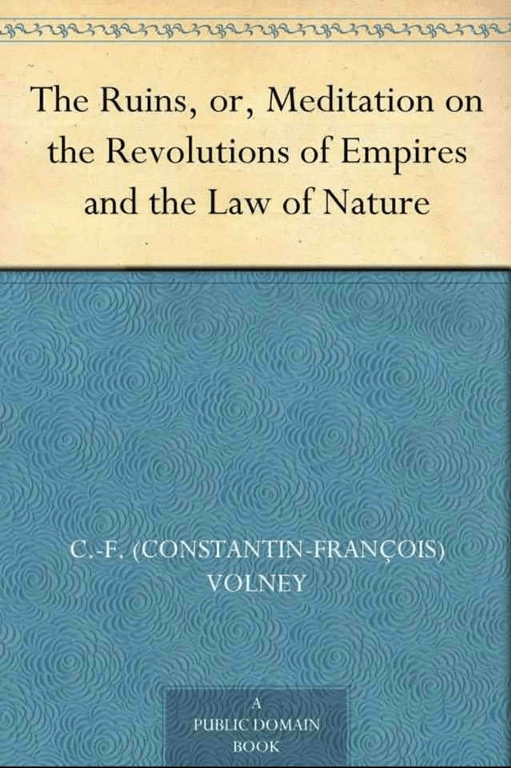
Here are some quotes from his book “The Ruins, or, Meditation on the Revolutions of Empires, And the Law of Nature:
Chapter 4: “It would be easy to multiply citations upon this subject; from all which it follows, that we have the strongest reasons to believe that the country neighboring to the tropic was the cradle of the sciences, and of consequence that the first learned nation was a nation of Blacks; for it is incontrovertible, that, by the term Ethiopians, the ancients meant to represent a people of black complexion and woolly hair.“
Chapter 4: “Those piles of ruins which you see in that narrow valley watered by the Nile, are the remains of opulent cities, the pride of the ancient kingdom of Aethiopia. … There a people, now forgotten, discovered while others were yet barbarians, the elements of the arts and sciences. A race of men now rejected from society for their sable (black) skin and frizzled hair, founded on the study of the laws of nature, those civil and religious systems which still govern the universe.”
Chapter 22: “It was, then, on the borders of the upper Nile, among a Black race of men, that was organized the complicated system of the worship of the stars, considered in relation to the productions of the earth and the labors of agriculture; and this first worship, characterized by their adoration under their own forms and natural attributes, was a simple proceeding of the human mind.”
Book publishers preface (Peter Eckler): “We are in reality indebted to the ancient Ethiopians, to the fervid imagination of the persecuted and despised Negro, for the various religious systems now so highly revered by the different branches of both the Semitic and Aryan races.“

 JERRELISME